Friday, 6 June 2014

Harrogate (part 1)

I wrote most of this post on the train back from last weekend's shenanigans at the Yorkshire Contract Bridge Association congress in Harrogate. I went down to Harrogate on Thursday night with Sally Stephens and Jun Pinder. Ian Angus brought Martin and Phil up to join us, and the others in the house were Phil Morrison, who works in Leeds, so came over on Saturday afternoon, and Ed Jones, who joined us on Saturday night after playing a Gold Cup match in Darlington. We all stayed in a big house in the centre of Harrogate, which is an excellent way to enjoy a bridge congress (we did the same at Peebles in December), and a lot cheaper than staying in a hotel.

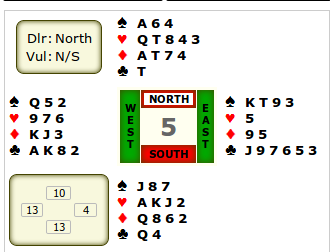
I played the Friday afternoon pairs with Jun, and we managed to finish above average, which I think is my only above average finish of the weekend... here's one hand where I was given an easy enough route to 11 tricks on the actual lead. On a different lead the play would have been interesting - not sure if I would, or should, have gotten it right.


West led a ♣, and now it's easy to make 11 tricks. You'e only ever going to lose tricks to a ♦ and the A♥. What's interesting about the hand is what happens if West leads a ♠. As the cards lie, you can now make 11 tricks as long as you duck the first ♠. East returns a ♣ (or a ♦, although you have to win that in hand), and now if West takes the A♥ when you lead towards the KQ (either time) he rectifies the count for a simple squeeze in ♠s and ♦s against his partner. If he doesn't (and you read the cards right), you can safely duck a ♦ into the East hand. I think you can usually get this right, as you can get a pretty good count on the East hand before you have to make the decision.

Against players who must have 6 cards for their weak 2s, this doesn't seem like the right line, as there's every chance you can avoid losing a spade trick if West has both A♥ and the third ♦, on which layouts these squeeze lines don't work. However, as the East hand was later described as super-maximum for a weak 2 in this pair's style, I think ducking the ♠ probably is right, as winning could be disastrous when West has a second ♠.

In the next instalment of the Harrogate chronicles, an interesting throw-in from Jun...

Sunday, 25 May 2014

Buchanan Men's Teams

So, last Sunday I went to the Berwick Congress. I played with Sally Stephens in the pairs, and Peter Stephen's (Martin and Phil's dad) in the teams, where Sally played with Martin. We had an unimpressive performance in the pairs, Sally doing a few silly things, and me doing a few equally silly things, to just sneak into the top 50 (out of 54). However, we rallied quite a lot in the teams and managed to finish a creditable 5th out of 21, not bad given that Sally really doesn't play that often, and me and Peter have only played together twice before.

I have one interesting hand from the session I played with Sally, which leads to the question: can dummy revoke? However, I can't find the hand records from that session right now, so I might write it up later.

On Tuesday it was the Men's teams in the Buchanan Congress. Playing with Peter Cairns and Jim McGlauchlin, who recently won the National Pairs and will be 1/3 of our team in the National League, we had high hopes going into the competition. However, we didn't even come close to competing for the prize - failing to win even a single match.

This was probably the hand of the night: 
At our table as, I expect, at most tables, the auction began 1♣ 4♦ X (some people might have opened 2♣, I guess or 1♠), and some people might have contented themselves with 3♦). I was sitting North, and passed without really thinking about it. On reflection, I think I should probably make a bid, although it's really not clear what. 6♦ is an obvious choice, or at least 5♦. However, maybe I should try something like 4NT, to really muddy the waters. 

At our table, our opponents stumbled into the grand after I passed (I think the auction concluded - 5♦ - 5♠ - 7♠). I'm not sure how much I like this bidding, as East really doesn't know if the grand can make. However, it looks quite likely to be at worst a 50% shot (the cards you're really interested in are the ♣Q, ♦A and ♥K, any two of which will mean you're at worst on a finesse, assuming the spades come in), and it's not clear how he's going to find out much more about his partner's hand - what do East's available bids even mean on this auction?

Maybe if the opponents end up doing this much guesswork at the 5 level even when I'm silent then I was right to stay out of things. Anyway, congratulations again to the winners, and to the team of Jim Forsyth and Nigel Guthrie, Charles and Vi Outred, who won the teams competition, which was held yesterday.

I'm off to Harrogate at the weekend with Martin and Phil Stephens, Jun Pinder, Ed Jones and various other "young" bridge players (I think Jun's probably the only one of us who still regularly gets referred to as young when doing anything other than playing bridge), so will hopefully have something to report back from there.

Thursday, 22 May 2014

Buchanan Congress

This week is the annual Buchanan Congress, which has been going since at least 1967. I know it's been going since at least 1967, because 1967 is the date of the first winners who are engraved on the trophy for the Congress Pairs, which is currently sitting on my mantlepiece...


We did reasonably well in the qualifying session for the pairs, finishing something like 5th with a score of 54%, and then were run-away winners in the final with 65%. I have to admit that it really didn't feel like a 65% game, and when Horst was reading out the results, I wasn't quite sure if we'd have just sneaked ahead of the second placed pairs (Grace and James Walker and Jim McGlauchlin and Peter Cairns), who were tied on about 58% or if we'd be just behind them.

As I mentioned in my last post, I've decided that it's probably time that I learn to actively try to count a bridge hand, rather than get by on general principles and having read a lot of books, and I've been practising this with GIB, and it has made a surprising difference to the experience of playing - one of the more unexpected benefits is that I actually hope to be defending on most boards, as then I'll get to practice my counting (counting a hand as declarer is the next thing on my list of skills to acquire...). And I get to defend twice as often as I'll get to declare!

Here's one where I was glad that I had a full count on the hand - I'll go through my thought processes in tedious detail...

The auction was - - 1♦ - 1♥ - 2♥ - 4♥. This seems like pretty reasonable bidding, North liking his singleton and his holding in partner's suit. I led the ♠10. This went to the 7, 2 and Ace. So I'm pretty confident partner has the ♠Q, but not quite sure how many ♠s he has yet. Declarer drew trumps then led a ♣ to the Q. Partner cashed the  ♠Q, and then played the ♣A. Declarer ruffed and exited with a ♠.

I'm now on play with two ♦s, 1♠ and 1♣ in my hand, but I know that declarer's starting shape was exactly 3-5-4-1, and he hasn't played a ♦ yet, so it's clear that I can afford to give him a ruff and discard in either of the black suits - if he has any ♦ losers then 1 ruff and discard isn't going to help him, whereas if he has the ♦J, then a ♦ might give the contract away. Now, I'd probably have played a black suit card anyway on general principles, but having a full count of the hand in this situation certainly made life easier.

Danny already blogged about this hand, where he and Anna managed to find their way into 3NT - we got 92% of the match points in the main final by playing in 2NT rather than a ♠ partial. As it happens 3NT is absolutely cast-iron (although it does require the ♠T to be in the East hand). 


We weren't quite as successful in the men's teams, despite the fact that our team-mates were one of the two pairs that finished joint 2nd in the pairs... I think both of us brought back cards that would have been lucky to win even one match playing with anyone in the event, but at least we were both terrible at once. Congratulations to the team of Alasdair Forbes, Bill Durning, Ian McClure and Raymond McShane, who won that event.

Saturday, 3 May 2014

Drills vs Skirmishes at bridge - a bleg

So, I seem to have gone the entire month of April without writing a single post to this blog. There were a few hands I kept meaning to write up, but never quite got round to it, and then I broke the screen on my Chromebook, so I didn't have a reasonable means of writing anything. I'm writing this with a new Bluetooth keyboard which I bought to use with the iPad as a stopgap before I get a new computer.

In the month I haven't been blogging, I've had a disastrous showing the National Pairs qualifier at the Buchanan, had a spectacular -600 in a vulnerable 3NT at an aggregate tournament, and a famous victory at the Melville Congress teams with Danny, Martin and Jake. There were a few interesting hands in those sessions, and in particular one hand where I'm fairly sure Martin andI should have bid a grand slam but didn't - I might well get to writing those up at some point this weekend. However, the title of this post is not about that.

The title of this post is taken from a concept which I read in the book Practice Perfect, which is written by some teachers who have spent a long time trying to figure out how people should practice something if they want to get good at it. One of the key distinctions they make is the difference between skirmishes and drills as a form of practice. A skirmish is something that accurately represents (or sometimes takes to extremes) the activity that you want to practice. So in basketball a skirmish is playing a game against your team-mates in practice, or even playing 2 on 2. A skirmish at bridge is playing a hand or even (in my opinion) solving a problem in a book. It very nearly simulates the entire experience of playing a bridge hand. A drill is an exercise that isolates one particular skill that you might need and allows you to practice it until you're good at it. So in basketball a drill might be shooting shots from a particular point on the court, or faking passes, etc. I've noticed a distinct lack of drills related to bridge. 

Here's something close to a complete list of all the drills I think I've ever come across explicitly described as drills:

1. starting with a number between 4 and 13, repeat all the possible divisions of 13 cards into groups of 4 where that is the longest suit. ie, commit to memory all the patterns such as 6331, 7222, 8410, 6430. Do this until you can instinctively complete the hand pattern given the first three numbers in the sequence. 

erm... that's it

There's also another book I own which I can't remember the name of (and can't find at the moment - I think I might have leant it to someone) which consists mostly of double dummy problems with 5 or less cards. This is also pretty close to a drill, as it teaches those patters in isolation.

Clearly the line between drill and skirmish isn't quite as clearcut as I might have suggested. For example, solving problems from a book, while I would regard it as a skirmish, is clearly not quite the full experience of playing a bridge hand, and if solving problems with a common theme, could well come closer to a drill. However, I think that my personal bridge education, and probably those of most people I know, has been quite heavily skirmish-biased. That's something I'm thinking about how to fix.

Luckily for me, I have a series of quite competent opponents who are happy to indulge me in whatever nonsense I may decide to throw at them. I'm talking, of course, about GIB. With the ability to play never-ending games against opponents who don't complain, there's lots of scope for designing good drills. Here's one I've been trying lately. Playing with GIB, I defend every hand (pass throughout, and re-deal when partner is declarer), and I make my sole mission in every hand to count declarer's shape. (I've also, incidentally, started doing this with the suits in order, so that a 3541 shape is different from 4531 - not sure yet if this is useful, but I figure it can't hurt). I think I've probably made more progress in my ability to count in defence in the 2 hours or so that I've been practicing this drill than in the 10 years or so that I've been playing the game.

Anyway, I was mostly wondering if anyone has any suggestions for other drills to improve specific bridge skills, suggestions for specific bridge skills that it would be worth designing drills for, or suggestions for other good sources of drills that already exist (or books that are more drill-like than skirmish-like). I'll probably be posting some more ideas for drills in future posts.

Saturday, 29 March 2014

Away in Falkirk

I played a match for Jake Corry's Merchiston team on Wednesday, away in Falkirk. I got the train to Falkirk High, and walked across Falkirk desperately seeking food. I finally gave in and bought a fairly terrible egg mayonnaise sandwich from a shop just round the corner from the bridge club, before rounding the corner and discovering a giant Tesco. I disposed of the terrible egg sandwich and bought something a bit more palatable from Tesco.


37.5% of our team arrived very late after they managed to fail to find each other at Edinburgh Airport. However, I was at one of the two tables that was able to get started on time. I was playing with David, who I played with in one previous match. Standard Acol-type things. We didn't get off to a great start. On the first two board we both went off in cold vulnerable games, by forgetting to draw trumps... on the fourth board I made 170 in 3♥ by cashing my 10 top tricks... 

Here's one hand where the bidding was subpar, I could have made it easily partway through, and then I did well to recover and bring home the vulnerable game at the end. Apart from the last bit, it is pretty much indicative of the standard of the play at our table.


I decided to open 1NT because I didn't really fancy a 2♣ rebid after 1♠ response from partner to 1♣. David intended this sequence to mean a hand that wanted to play in 4♠ if I had four ♠s and 3♦ otherwise. I didn't know this, and thought it was forcing. Anyway, West led the ♠3, and East won this trick with the J. The ♣8 switch went to the 9, T and A, and then I made the slightly weird play of a club to the J. 

For some reason I'd decided that if I had to lose a club anyway, I might as well do it straight away. I'm not really sure why doubleton queen didn't occur to me... Anyway, after LHO switched to a ♥ to the Q and A, that left me with 8 tricks. I ran the clubs, to come down to an ending that was something like this (no, I have no idea why East thought it was a good idea to pitch a diamond, either... )


Note that it doesn't actually matter what East has, West is now in some trouble when I play off the ♣2. If he pitches a ♥, then I can just duck a ♥ for my 9th trick, a spade gives up the long ♠, and a ♦ doesn't help either - I can now play the ♦A to strip West's last exit card, and endplay him with the fourth ♠. This is what happened. I was quite happy with the result at the time, as keeping track of that sort of end position is one of the areas in which I'm actively hoping to improve my play at the moment. However, I could have made life easier by just picking up the club suit when it was handed to me on a plate...

West needs to pitch all of his ♦s earlier and keep another ♥ to beat this I think, which is certainly not easy.

Anyway, despite that we didn't have a particularly impressive card, and the match was lost by a few hundred points, which means 2-1 in the way this league works. I think that leaves us comfortably mid-table in the first division, and I think this was our last game. 

I'll be playing with Norman a couple of times next week, National Pairs final on Saturday, and as a warm-up, the final round of the Buchanan Winter Pairs on Wednesday. In the latter, I think we need a score in excess of 69% to overtake Danny and Anna, who are currently sitting in 2nd place. To catch the leaders I think we'd need something closer to 90... 

Sunday, 16 March 2014

West District Pairs Final

After a strong showing in the semi-final, we went into the West District Pairs somewhat hopeful. Needless to say, our hopes were not fulfilled... well done John DiMambro and Hugh McCash, who won the competition, the only pair to score over 60%. They'll be accompanied by Shirish Chotai and Les Verth if they decide to make the trip up to the highlands to compete in the inter-district pairs (the Strang trophy, I think it's called). 

Although we only managed 50%, I felt like I was back to playing a reasonable standard of bridge - I knew what was going on a lot more often than I have over the past month or so. 

Here's one where we did well because the opponents made a classic mistake... what Hugh Kelsey referred to in How to Improve Your Bridge as "picking daisies". Let's start with a lead problem. Playing pairs, what do you lead from this hand, on this auction (1NT 12-14, if that matters).


I think it's close, but the majority choice in the room was the 7 of spades. I think I'd have picked the diamond 8, as the spades seems more likely to be giving away a trick (it's not even clear to me that the 7 is the right card to lead from that holding). However, you're pretty much leading blind. 

Now consider the same hand on this auction: 

2♠ was a transfer to ♣s, and 2NT showed 1 of the top 3 honours. What is the best lead now?

It might not be clear what to lead, but I figured that if the opponents were going to be able to run 6 club tricks, I might as well let them get that out of the way immediately, and then let them figure out how to make any other tricks themselves. Yes, there's a chance that we have 5 cashing tricks, but it doesn't look all that likely from my side, and its matchpoints, so I'm not necessarily aiming to beat this contract. Maybe my reasoning was wrong, but I certainly had more information to go on than the majority of other Wests in the room. 

The full hand was this: 

As you can see, the 2♠ bid really served no purpose - North was always just going to bid 3NT no matter what her partner responded, and so the extra information could only be helpful to the defence. 

Here's one more hand, where our opponents scored significantly above average for making 6♥, with 13 top tricks... would you and your partner be able to bid these cards to 7♥? (or, even better, 7NT?)


While in this instance 7♥ is pretty much 100% (7NT is actually 100% - there are 13 tricks on top, and no danger of a ruff), it's worth noting that in this field the grand would have had to be really, really good odds to be worth bidding. 6♥ + 1 was worth 9/12 matchpoints, so you're betting at 3:1 if you do contract for all 13 tricks.  Marginal grands really aren't worth bidding at matchpoints... 

I've no idea how so much of the field managed to stay out of slam. Perhaps they weren't given a helping hand by South bidding 2♠? Although I don't see how anyone could stay quiet with the South hand.

Sunday, 2 March 2014

Men's Competitions

This weekend was the Men's Pairs and the Men's Teams in Dundee. I was playing in the pairs with Jun Pinder and in the teams with Jake Corry (Robert Clow and Derek Peden were our team-mates). David Liggat and Roy Bennet won the pairs (I think repeating their victory from last year), and Jun and I finished just slightly below 50% - not a particularly impressive showing from either of us, I think, although Jun did warn me beforehand that matchpoints isn't his forte.

As I left the teams, about an hour or so ago, Ian Sime, John Matheson, Brian Short and Alan Goodman had been declared the winners by 1 VP. There was something odd going on with board 10:


This was the board (and the auction) at our table. I was sitting north, and led the ♠K. Jake dropped the T, and I fell from grace, switching to a ♥, which gives the contract away, as now declarer can just draw trumps. As Jake pointed out afterwards, I should almost certainly get this right. With Qx in ♦, I know declarer doesn't have a dummy entry, so even if he does have a stiff spade, setting up the ♠Q won't do any harm, and so if he has two heart losers, they're not going anywhere.

The reason this board is controversial is that by the time it reached out team-mates, the East-West hands had been switched, which obviously makes comparison impossible (they went off in 5♦) I think the decision the organisers made was to scrap the board altogether (although the impression I got was that it didn't actually make a difference to the final result). There was a suggestion they could scrap it only in the matches where it was fouled. I guess there's also the question of whether there should be penalties for the team that messed it up. In any case, our results were bad enough as it was, without re-introducing that one.

There were a few more hands that I might get round to writing up at some point, but overall I wasn't particularly happy with my performance over the weekend. I felt like I was mostly playing automatically - jut following suit and doing the thing that seemed "normal", rather than actually thinking about each hand. It's  a habit that it's easy to get into, and I had been getting better at actually playing each board rather than just going through the motions. Not sure what went wrong this weekend.

Anyway, Jess did end up coming out for Saturday night. In fact, she ended up coming out on Saturday afternoon (due to a misunderstanding), and spent about 3 hours trying and failing to buy food in various places around Dundee, before I finally met up with her and we headed out to Nando's for a not-particularly-thrilling-but-at-least-you-know-what-you're-getting meal. She then headed to Aberdeen for a rugby game in the morning, and is off to Inverness for an academic workshop tomorrow. With a government meeting in Edinburgh on Wednesday, that means she'll have visited 5 of Scotland's 7 cities in just 4 days (and passed through Stirling and Perth on the train), which I consider a much more impressive achievement than my finishing somewhat below average in a couple of bridge events.

Winter Pairs on Wednesday, then I'm off to Tenerife for a couple weeks - we have the final of the West District Pairs on the day I get back, and then I'm sure there'll be more bridge coming up...

ETA: added the hand from board 10 - which Jake had already posted in the comments below.