Monday, 23 November 2015

National League weekend 2

The second weekend of the National League was this weekend. Full results are available here. Congratulations to the team of Mike Ash, Alex Adamson, Finlay Marshall, Arend Bayer and Patrick Home, who won the division. They went in as favourites (and in fact would only narrowly have missed out on automatically being in the first division), and won out in the end. Congratulations also to the Burn team, who will get to play in the First Division next season. Also well done to Brian Short, Alan Goodman, Sam Punch and Stephen Peterkin, who won the first division with over a match to spare (Derek Saunders also played in that team, but I think he only played the Saturday of the second weekend, so hadn't played enough boards to qualify for the Camrose). Phil S and Frazer will be the third pair in the Camrose team for the first weekend, with Alex and Phil M as their reserves.


We did a lot better in the second weekend than we did in the first, but had left ourselves with just too much to do to catch the teams in front. Even beating the Burn team 15-5 on Saturday didn't do enough to close the gap when we narrowly lost a couple of matches in the afternoon. We had the best score in the second weekend, narrowly ahead of Ferguson and Adamson. Here's a full table with scores from both weekends (since the version on the national league website requires you to do some arithmetic). 


CaptainFirst Weekend ScoreSecond Weekend ScoreTotal Score
ADAMSON87.778.08165.78
BURN90.170.48160.58
FABEN64.2285.44149.66
SHENKIN74.6967.45142.14
FERGUSON56.4181.37137.78
CLOW53.2569.69122.94
GUTHRIE53.4367.13120.56
WICKENS81.8336.73118.56

♣♦♥♠


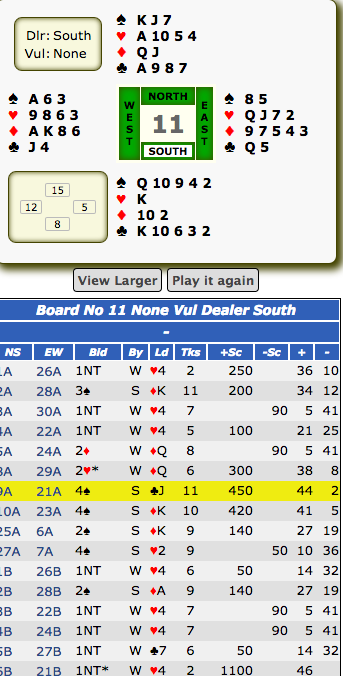
The most exciting hand of the weekend was the very first board of the very first set (although we didn't play it first):


Adam opened the North hand 1S. By agreement we open most 7 loser 8 counts, and he has a 5 loser 7 count, so this isn't horribly off system (he does have ways of showing a longer minor in most auctions). East decided not to bid, and after a bit of thought, I bid 3NT. I wasn't sure whether we had any explicit agreement about 3NT, but it pretty much has to show this sort of hand. Adam asked me what my minor was with 4C, and when he jumped to 6, I figured that AKQJ9754 was almost certainly a better trump suit than whatever he had in mind, and corrected. East wasn't kind enough ot make a Lightner double, so I rolled in an easy 940. Note that you can make 7 of either minor, but only if you arrange to play it from the short hand to avoid the ruff. 

The auction went slightly differently at the other table: 


Having right-sided the contract, there was no lead that could avoid a couple of overtricks in this contract, and we chalked up 18 IMPs for 940+850... Note that 13 tricks in hearts are cold if played by East, but West can only make 12. 

We spent a few minutes in the pub wondering if you could construct a hand where each player can make exactly one grand slam, before realising that we pretty much had a template for one here - swap a few of North's spades with a few of East's diamonds, and West is cold for 13 tricks in spades, whereas East can only make 12. Each player can make exactly one grand slam. 

♣♦♥♠

I've enjoyed playing the National League this year, and will definitely be looking to enter again next season. Whether Adam and I will stick with the strong diamond, or find anyone who's willing to play in a team with us if we do is yet to be seen...

The organisers currently have a consultation going on to come up with suggestions for the format. While obviously I have a selfish interest in keeping the second/third divisions as they were at the end of this season, I'm not convinced I'd bother entering if I knew I had to play in the third division for both weekends, so I think there's probably a good argument for keeping the format the same as it was this year. It also seems fairer to people who didn't enter this year for whatever reason, or want to rearrange their teams. Given that the league is essentially an international trial, I think that for it to take a full 2 years before you can even get into a position to be eligible for international selection is probably a bit much.

It did feel slightly unfair that the shorter matches in the first weekend counted the same as the longer matches in the second weekend, but at least in the second division they weren't that much shorter (and we still wouldn't have made it into second place even if you scaled up the second weekend scores by a factor of 16/11), so overall I think the format worked, I just wish we'd managed to play a bit better in the first weekend, so we could at least have kept it interesting.

Sunday, 8 November 2015

Winter Pairs 3

The Winter Pairs is the Buchanan club's main pairs competition, the best 4 scores out of 8 collected from September to April count towards your final score. Last year, me and Norman finished third overall. This year, we started off badly with a below-average round, but have now followed it up with two scores in excess of 60%. We'll need a couple of really big scores to be in with a chance of winning, but it's a good start. 

Here's one where I made a different decision to literally everyone else in the room who was faced with the same problem (although I don't know how many people that was). 


Playing matchpoints, what's your call? I thought it was a pretty easy pass... I only have 2 cards in each major, I have a bare 12 points. Partner hasn't opened either a weak 2 in a major or a Lucas 2, so I thought it was long odds on that the opponents had a major suit fit, and are going out outbid us if I come into the auction. I just don't think it's odds on that I go positive if I open this hand, which is surely the only consideration when opening 4th seat playing matchpoints. 

As you can see from the traveller (slightly rotated from above - I was actually East), no-one else was both put into the same position as me and made the same decision. I can only assume that a number of people opened in third seat and that some were playing a weak NT, and decided to open my cards 1N, but I'm sure at least a few people must have been in my position, and decided to go ahead and open anyway. To be fair, I don't think I would have gone down in 2♣, so if I was destined to buy the contract there, then I was not correct to pass. 


I posted the hand on Bridge Winners, and as I write this it's exactly split down the middle between 1♣ and pass, so clearly pass isn't quite as clear cut as I thought, but it worked out well for us this time. 

We had a few unlucky boards towards the beginning, made a few mistakes in the middle, and were given a few gifts at the end, all adding up to 61.51%, which is a decent score, but almost certainly won't be one of our top 4 scores if we do go on to win the competition. 

Next week, East District League match - I'm playing with Adam, so we can get a bit of practice before National League, and the Chris Harrison Pivot Teams, where each member of the team plays 8 boards with each other member of the team. Norman and I are playing with Maria Jackson and John Di Mambro, and we're hoping we can finally win a Buchanan club competition - last season we finished either second or third in every single one... 

Monday, 26 October 2015

National League Weekend 1

We played the first weekend of the National League this weekend. With the Second Division splitting to form Second and Third Divisions after the first weekend, our first goal was to avoid qualifying for the third division. With a couple of matches to go, it was looking close, and then we lost heavily to the Burn team in our penultimate match, and didn't think we were in with much of a chance. Luckily, a few of the other teams who were on the verge of qualifying also lost, and a big win in our last match was enough to see us sneak through in 7th place (8 teams in the 2nd division). You can find the full table here

RankNameScoreCarryover
1ADAMSON184.17 87.70
2WICKENS172.96 81.83 
3SHENKIN157.85 74.69 
4BURN147.33 90.10 
5GUTHRIE140.18 49.80 
6CLOW137.05 53.25 
7FABEN127.37 64.22 
8FERGUSON119.30 56.41 

We do actually move up a bit when you remove the games against the lower six teams, with a somewhat more creditable 6th place, but we're still a good way behind the three teams at the top. We did manage to beat both Wickens and Adamson in the first round, but it will have to be a pretty spectacular set of scores next weekend if we're going to overcome that sort of difference. Ian Burn's team is the biggest winner from discarding the matches against the bottom six, gaining a full 40 VPs when compared to Adamson, and actually starting the second weekend at the top of the division, despite only finishing 4th overall.

The reason we didn't do better is mostly because we didn't play well enough. There were, as there always are, several chances that we could have taken which would have seen us win the matches we lost. We managed an impressive 20 IMP swing out on one board (both 6CX and 4HX+2 making against us...). Our team mates had a similar sort of weekend, some ups and some downs. If you believe the Butler, we were pretty evenly matched - they were .19 IMPs a board better than us, just sneaking positive, whereas we were just negative.

Adam and I had a couple of system mix-ups, but most of our errors were just straight up errors, and could just as easily have been made if we had been playing Culbertson, instead of the strong diamond we (for some reason) have decided to adopt. 

Here's one where I think we were a bit unlucky:


Seeing both hands, you might not be overly excited to play in 6 clubs, but on the auction I (with the West cards) knew that Adam had exactly a 4-3-1-5 shape and 11-15 points... given that there were only 13 points missing outside of diamonds, I felt that 6 clubs was at worst going to be an even money chance, and just bid it. Adam played it quite nicely, winning the opening lead, ruffing two diamonds and playing off three rounds of hearts, hoping North would have to win and would be endplayed in spades. Unfortunately North had another club to return, and the slam was one off. South did have the spade 10, so the slam can make double dummy on the intrafinesse in spades, but that wasn't really a very realistic play, unless you're wiling to run all the clubs and back yourself to read the spade suit when South has to find two discards. 

We'll get a bit more practice in before the next weekend, and hopefully I'll be a bit sharper, as we'll be more definitely in the middle of bridge season. First goal, once again, will be to avoid qualifying for the third division next season... 

Tuesday, 13 October 2015

Bridge!

I played with Norman against Gilmorehill in a match on Monday night. We lost 12-4. Our first defeat of the season, despite already having played two strong teams (GUU and St Andrew). It's looking hopeful that we might manage to play in the first division for another season. 

There was one hand that I'm quite proud of, although it's one that I should always make (and I'm not particularly proud of the auction. I'm actually quite grateful to Jim McMenemy, who took so long to find his return at trick 4 that I had a chance to go through all of the possibilities, and find the right line in the end.

Here's the NS cards:


And here's the auction:


Our auction was not exactly textbook - I think I should probably have passed 5 and let Norman decide, but I wasn't completely confident he'd always double, and I didn't like the fact that he didn't know we had a (likely) double fit. When dummy came down I could see we'd given up at least 500 and probably 800, so I'd better make 5.

John on my left led a small , which I won on the table, and played a immediately. Jim went into the tank for what I think was literally 5 minutes thinking about his return, before returning the Q. So, what are my chances in 5?

Well, there's a 3-3 spade break. Then I can get away one of my s on the last . But that's really not very likely given Jim's double. Jim could have a singleton honour, then I can finesse in , and the is my only loser. A lot more likely is the 3-2 break, but it's now too late for me to take advantage of that (unless John has the 3rd and doesn't have another to return). Maybe I should have tried ducking a at trick 2, but that was risky in case someone could ruff (likely given that opps bid to the 5 level on not very many points).

There are also some remote squeeze chances - if Jim does have 3 and 4, then he can be squeezed between those two suits, but that really doesn't seem very likely at all. It's even less likely when he follows three times when I draw trumps...

So, the play has gone - to the K, ducked, !Q returned to the A, AKQ of , RHO following twice. What do you do next?

I cashed the ♦K, both defenders following small, and then I led the T. John actually made life easy for me now by covering with the queen. If he covers with the J I actually still have a guess (if I believe he's capable of covering with the J from Jxx), but by this point I had decided how I was playing the hand, and was going to get it right anyway (I'm going to assume he was showing me some respect, and assuming that I was always getting it right. 

I ducked this ,  and when as expected Jim showed out and John didn't have another to return, I could claim the rest with the aid of a ♦ finesse.

The full hand:

This hand is relatively straightforward if you're paying attention, but it's exactly the sort of hand I usually get wrong. If Jim had made a passive return, it would actually have made my life more difficult, as I'd still have had the option of ducking the (or playing for the unlikely squeeze). I think I should still get it right, but we'll never know if I would have.


♣♦♥♠


Monday, 10 August 2015

Hand Evaluation Through the Ages

I'll start this with a quiz of sorts. What would you open either of the following two hands, playing standard modern Acol? And roughly what point-count equivalent would you say they are (taking into account shape, honour location, etc)? 

Hand A:

Hand B: 


My answer on both hands in 1NT, I would be extremely surprised to find anyone who answered differently. Hand A might possible be worth upgrading if it were 4432 rather than 4333, but I suspect you'd also have to shuffle that Jack into a more useful position (something like Kxx xx AJxx AQxx might be too strong to open a weak NT, but that's quite a long way from the actual hand).

My answer to the second question is that I would rate hand A as a slightly weak 14 count (maybe 13.5, or something), and hand B as a weak 13 count (maybe 12.5, possibly even less). 

I ran both hands through Jeff Goldsmith's automated version of the Kaplan and Rubens/Danny Kleinman hand evaluation schemes, and it approximately agrees with me, although it's even more extreme in it's downgrading (I suspect both methods deduct a full point for the 4333 shape). The calculator rates Hand A as 12.80/13+ and Hand B as 10.95(!)/12+. 

Now, you ask, why am I interested in the evaluation of two such boring weak no trump hands? It's because I found both in a book by SJ Simon (A Design for Bidding) from the 1940s. He used the Hand B as an example of a hand that's too strong to open 1NT when playing a weak no trump:
"You cannot afford to have partner pass with 11 points, particularly 11 points made up without Aces"
What changed? Have we really gotten so much better at evaluating hands that we can completely flip the evaluation of two such seemingly banal opening bids? Did people just get so much better at defending since Simon's day that thin games don't make as often?

Saturday, 1 August 2015

Matchpoint Monday

I'm back in Glasgow, and have managed to get a couple of games in with Norman since I returned. Last Monday we played in "Matchpoint Monday", which is a Monday on which the club night is matchpionts, rather than aggregate. The whole club participates in the same tournamnent (rather than scoring the individual rooms separately), and so there's actually a non-trivial amount of prize money at stake. We finished in first place, with a nice haul of £12.50. 

Here was a hand where I spent a long time over the play. As it turns out, unnecessarily...


I opened the South hand a Lucas 2S, and ended up in a very good game. After the lead of the jack of clubs, there's a fair bit to think about. If clubs don't break, and East has at least one diamond honour (which, although it happens not to be the case, seems odds on on the lead). Ideally you'd like to unblock the HK and pitch a diamond on the HA, but if you win the lead in hand, there's no route back to dummy for a pitch, and you've given up on making 5 club tricks if the lead does turn out to be a singleton, but the opponents are unable to take their ruffs. 

I eventually won the lead in hand, crossed to the HK and played a trump towards the KJ. This shouldn't really work if the opponents do have a ruff coming (they knew I have at least 4 clubs, and probably 5 from the auction), and I was pretty certain the lead was a singleton (leading from Jx in declarer's second suit isn't very attractive), but in the end I decided I didn't have anything better to do. 

I was also thinking about the fact that even if clubs were 2-2, my only realistic chance of 11 tricks was to sneak a diamond pitch in before I lost to the trump ace. As it turns out, that 11th trick was worth exactly 2 matchpoints - I hadn't taken into account the fact that most people would have no way to bid this game.

After a month in India in June, and moving house in July, I'm about to start settling back into a "normal" life. Adam and I will have to do a lot more practice together if we're going to make a serious go at the National League Second Division, and I'm back to playing most weeks with Norman, so hopefully I'll gather enough material for more than 1 post in August.

Sunday, 28 June 2015

T Nagar Club

You may (or may not) have noticed a slight hiatus in my bridge-blogging recently. It was probably already slowing down in May, but I haven't posted at all in June, and that's because I've been working away in Chennai India. One of the first things I did when I got here was email the local bridge club to try to organise a game. However, I only managed to get there last Tuesday (after being here for more than three weeks). In part, because the Indian National championships were on in Bangalore last week, so the local club wasn't playing their usual weekly tournaments. 

I arranged to play with Sathish by email, agreeing (with some slight apprehension) to play whatever system he chose to send me. I was somewhat relieved when he sent me something that looked pretty much like what I play usually at home, with a few minor variations (for example, a raise to 2 of a minor is 9-11 with 5 card support - I never actually got around to finding out what a raise to 3 of a minor was...), and we agreed to meet at the club on Tuesday night. 


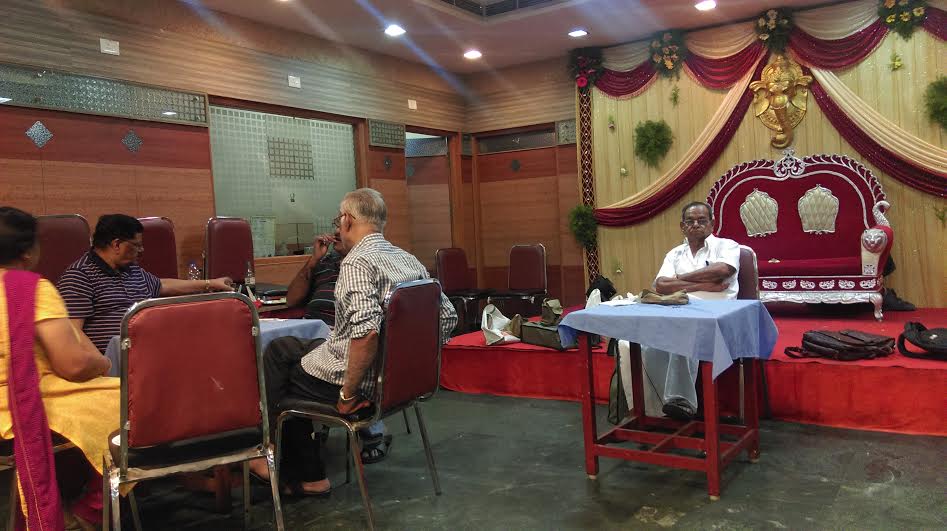
I turned up at the T Nagar Club about 40 minutes before play was due to start (having left a lot of time for the highly unpredictable traffic), and walked into a room where about 4 full tables were already occupied with people chatting away in Tamil. As you can see from the photos above, the setting looked quite definitely Indian, but also quite definitely like a bridge club. I greeted a couple of people, told them I'd already arranged a partner, and sat down at a table to wait. After about 2 minutes of conversation in Tamil, I heard: "T854 spades, 98 hearts, AKJ3 diamonds, Q53 clubs, favourable, it goes pass, pass to you". It turns out that in India the language of bridge is English, and I was able to follow the rest of the story. 

Interspersed with a few words of Tamil, he went on to explain how his light 1♦ opener had allowed his partner to find the right lead against 4♠. They cashed the first three tricks in diamonds, everyone following, and he played the 13th ♦. With ♠A7 visible in dummy, partner only had to ruff with the ♠9, and he'd promote a trump trick in our hero's hand. We all know the end of the story - partner had the ♠9, but declined to ruff, declarer was able to draw trumps and the contract made. When Sathish finally arrived, we cleared up a couple of details of the bidding we hadn't managed to confirm by email, and kicked off the proceedings.

 I started off disappointingly guessing a key suit incorrectly in a normal 1NT contract, and failing to make an overtrick. According to the scorecard, this was worth 40% of the matchpoints, so I suspect that there were several more available if I'd gotten it right. We had a generally successful session (including beating 2♥XX by 3 tricks on one board...), but another couple of bad boards: one where I made a silly raise, and one where Sathish just forgot to ruff a loser before drawing trumps meant that our score was only good enough for second place. 

 Here's a board where we did well. I'll start off with the bidding problem:

What's your call with this hand? If you do open 1♥, what is rebid if partner bids 1NT (playing "standard" 2/1 without many agreements at all (I don't think we'd agreed to play Drury...). I decided to open 1♥, and  ended up playing the hand in 2♥. The lead is a small ♣, how do you play? 


I decided to try and get my ♠ ruff, as I couldn't really see a way to even 7 tricks without it, and so played a ♠ out of my hand immediately after ruffing the ♣. This was won on my left, and after quite a lot of thought, LHO finally played a ♥. I think any thought at all on this trick pretty much marks him with the ♥Q, as a ♥ to cut down the ruffs seems automatic without it, and I think the decision to finally play a ♥ anyway probably means he has Qxxx (however sound this reasoning is, it turned out to be correct...). I was now allowed to scramble home, making 5♥s 2♦s and a ruff (I won this trick in hand, ruffed a ♠, ruffed a ♣, ran the ♦Q which lost, and was relieved when E didn't have a ♣ for a trump promotion, and everyone followed to the third round of ♦s). Several tables had NS in much worse part score and at one table someone managed to beat 2♥ by two tricks, so this was a good score for us. I think 2♥-1 is probably the normal score, assuming EW don't manage to find the ♥ lead from Qxxx which cuts out the ♠ ruff. 

 An interesting evening, with a few differences form a British bridge club, and even more similarities. Shame I only managed to make it down once, but if I'm ever back in Chennai again, I'll be sure to pay a visit.